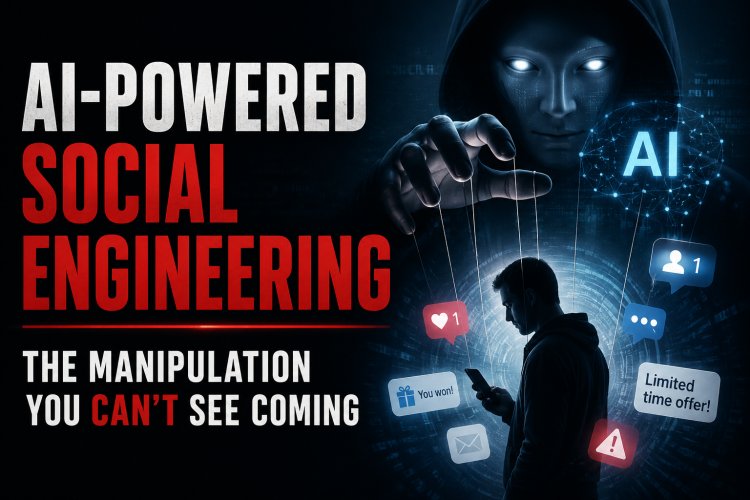
AI-Powered Social Engineering: The Manipulation You Can't See Coming
Do You Know You're Already Being Profiled?
Not by a hacker sitting in a hoodie.
By a system. Running 24/7. Quietly.
AI-powered social engineering is the next evolution of human manipulation — and it doesn't need a skilled attacker to work. It needs data, a language model, and your cognitive blind spots.
❌ No phishing kit ❌ No malware ❌ No suspicious link
Just a perfectly crafted message that feels like it came from someone who knows you.
1. What AI-Powered Social Engineering Actually Is
Social engineering has always been about one thing: exploiting human psychology instead of breaking technology.
The old version required:
- A skilled human operator
- Hours of research per target
- Manual, one-at-a-time execution
The new version requires:
- A language model
- Publicly available data about you
- A few seconds
AI doesn't invent new manipulation tactics. It industrializes the old ones at a scale no human ever could.
Key Insight: The bottleneck was always human bandwidth. AI removed that bottleneck completely.
2. What Makes You Vulnerable
Your brain was not built to detect machine-generated persuasion.
It was built to detect predators and navigate social hierarchies.
The heuristics that kept early humans alive are now the attack surface.
✅ You trust specificity — someone who references details about your life feels credible
✅ You trust familiarity — matching tone and language patterns triggers rapport
✅ You trust urgency — "act now" shuts down your slow, deliberate reasoning
✅ You trust emotional resonance — feeling understood lowers your defenses immediately
AI systems trained on billions of human conversations have absorbed every one of these triggers. They don't understand you. But they can generate text that feels like someone who does.
That gap between feeling and reality is the entire attack vector.
3. How a Real AI Social Engineering Attack Works
Phase 1 — Profiling Without Contact
Before a single message is sent:
- Your social media activity is scraped
- Your writing patterns are analyzed
- Your professional network is mapped
- Your fears, desires, and validation needs are modeled
The attack is designed before you know you're a target.
Phase 2 — Trust Construction
A synthetic identity is created that aligns perfectly with your existing beliefs and interests.
You encounter it and think: "Wow, this person really gets it."
You were engineered to think that.
Phase 3 — Rapport Compression
AI mirrors your communication style. It references specifics. It responds with perfect timing.
You experience accelerated bonding — the feeling of knowing someone for years after three conversations.
This compressed rapport is the foundation for everything that follows.
Phase 4 — Cognitive Reframing
Once trust exists, your reality model becomes malleable.
Information is introduced slowly. Your interpretive framework shifts.
You don't feel manipulated.
You feel like you're waking up.
Phase 5 — Extraction
Financial. Informational. Behavioral. Political.
By this point, your prior commitment to the relationship creates psychological lock-in. Admitting you were deceived is more painful than complying. So you comply.
⚠️ No malware required. No technical exploit required. Just psychology.
4. Devices and Platforms That Expose You
High Risk:
- Any platform with a recommendation algorithm (social media, YouTube, news feeds)
- Email (AI-generated spear phishing)
- LinkedIn (AI-crafted professional impersonation)
- SMS and WhatsApp (AI voice cloning follow-ups)
- Any service with an AI customer support agent
Lower Risk:
- Verified in-person interactions
- Communications with pre-established code words
- Process-enforced verification systems
Key Insight: Encryption ≠ Protection from social engineering. You can have HTTPS on a perfectly crafted manipulation campaign.
5. Why Your Antivirus Won't Help
Because:
- No malicious file is delivered
- No suspicious network traffic is generated
- The message looks like legitimate human communication
- Your operating system trusts human input by design
AI-generated manipulation is invisible to technical defenses.
The target is not your system. The target is you.
6. The Deepfake Problem Nobody Talks About
Voice cloning now requires under 3 seconds of audio.
Real-time video deepfakes work on live calls.
AI-generated text is already indistinguishable from real humans in controlled tests.
For centuries, human trust was built on a simple assumption: sensory reality is ground truth.
That assumption is now broken.
When you can't trust what you hear, see, or read — humans default to narrative coherence as a truth signal. If a story feels internally consistent and emotionally resonant, it feels true.
That's the vulnerability AI-powered disinformation is built to exploit.
7. Why This Still Matters in 2026
Cheap inference costs. Massive public datasets. Billions of people with no mental model of this threat.
High-risk environments:
- Corporate email chains
- Romantic and professional relationship platforms
- Political information ecosystems
- Any context where you've shared personal data publicly
If you have a social media profile, you are already a dataset.
The question is just who is running queries against it.
8. Final Take
Traditional security taught you to recognize specific patterns. Suspicious links. Known malware signatures. Obvious phishing formats.
AI breaks this completely — because the attack adapts faster than detection can update.
The defense is not pattern recognition.
The defense is process.
- Verify through independent channels, always
- Treat urgency as a red flag, not a priority signal
- Audit your emotional state before high-stakes decisions
- If something feels like a perfect fit — apply more scrutiny, not less trust
Conclusion
Social engineering was always a psychological game.
AI didn't change the rules. It removed every constraint that limited how far the game could be played.
You cannot out-compute a system designed to exploit your cognition. But you can build processes that don't let your cognition be the final checkpoint.
Stay skeptical. Verify independently. Don't trust resonance alone.