Someone May Already Have Stolen Your Data. They're Just Waiting to Read It.
Hackers are collecting your encrypted data today to unlock it when quantum computers arrive. Here's what that means for you — in plain English.
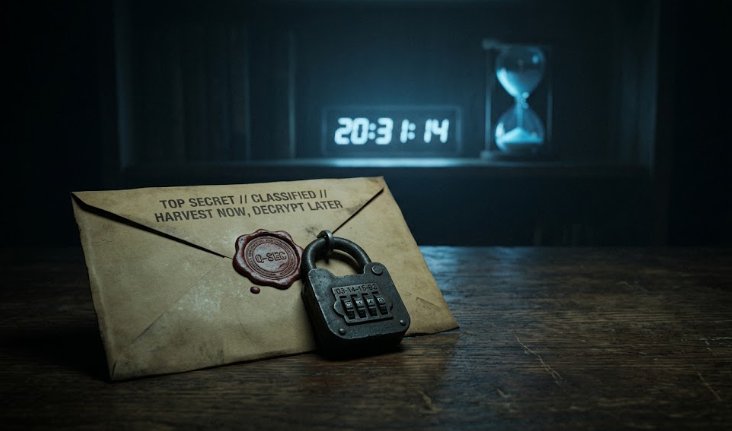
Someone May Already Have Stolen Your Data. They're Just Waiting to Read It.
You locked your house. You set the alarm. You did everything right.
But what if someone had already made a copy of your key — and was simply waiting for the day they could build a door that fit it?
That's not a metaphor from a spy novel. It's a description of something happening on the internet right now, quietly, to data belonging to governments, banks, hospitals — and very possibly, to you.
It's called Harvest Now, Decrypt Later. And the unsettling part isn't what it does. It's how patiently it waits.
Let's Start With the Basics: What Is Encryption?
Before anything else, it helps to understand what encryption actually is — because this whole story depends on it.
When you send a message, make an online payment, or log into any website, your data doesn't travel across the internet in plain text. It gets scrambled — converted into an unreadable jumble of characters that only the intended recipient can unscramble. That scrambling process is encryption.
Think of it like a combination lock. The data goes in, the lock clicks shut, and only someone with the right combination can open it. The "combination" in this case is a mathematical key so complex that even the fastest computers in the world today would take millions of years to guess it by brute force.
That's why encryption has been the backbone of internet security for decades. It works — because cracking it is, for now, practically impossible.
The word "for now" is doing a lot of heavy lifting in that sentence.
Enter the Quantum Computer
Here's where things get interesting — and a little worrying.
A quantum computer is not just a faster version of the computer on your desk. It's a fundamentally different kind of machine that processes information in a completely different way. Without getting into the physics, the short version is this: certain mathematical problems that would take a regular computer millions of years to solve, a quantum computer could solve in minutes.
One of those problems? The exact math that makes today's encryption so hard to crack.
Quantum computers powerful enough to do this don't exist yet. The most advanced ones today are still experimental, prone to errors, and nowhere near capable of breaking real-world encryption. But the direction of progress is clear, and the pace is accelerating. Researchers now estimate that a quantum computer capable of breaking common encryption standards could exist somewhere between 2030 and 2035. Some recent research suggests it could happen even sooner.
This is where most people exhale and think: "Okay, that's a decade away. Not my problem right now."
That's exactly the wrong conclusion.
The Attack That Doesn't Need to Rush
Here's the genius — and the danger — of Harvest Now, Decrypt Later.
Attackers don't need a quantum computer today. They just need to be early. The strategy works in three steps, and two of them are already happening:
Step 1: Intercept and collect encrypted data — through hacked networks, compromised servers, intercepted communications, or stolen files.
Step 2: Store it. Do absolutely nothing with it. Just wait.
Step 3: When quantum computers eventually arrive and become capable of breaking encryption — go back to that stored data and unlock all of it, retroactively.
The theft happens today. The reading happens years later. And the person whose data was stolen has no idea anything happened, because the data was encrypted — it looked like useless scrambled noise to anyone who intercepted it.
It's the digital equivalent of someone photocopying every private letter you've ever written and storing them in a warehouse — waiting for the day they invent a machine that can decode invisible ink. The letters are already gone. The machine just hasn't arrived yet.
Direct Answer Box
Question: What is a Harvest Now, Decrypt Later attack?
It's a strategy where attackers collect encrypted data today — data they can't read yet — and store it until quantum computers become powerful enough to break the encryption. The theft is happening now. The damage arrives years later, making it one of the hardest threats to defend against because most people don't even know it's occurring.
Why This Isn't Science Fiction
A 2023 Deloitte survey found that over half of professionals at quantum-aware organizations believed their organization was already at risk of HNDL attacks. That's not a fringe opinion — it's the view of people whose job it is to understand this threat.
And the timeline is moving faster than expected. Research published between 2025 and early 2026 significantly reduced the estimated computing power needed to break common encryption — what scientists once thought would require tens of millions of specialized processors may require far fewer than previously assumed. The goalposts are shifting.
Meanwhile, the security community has a concept called Q-Day — the moment a quantum computer successfully cracks modern encryption at scale. No one knows exactly when Q-Day arrives. But the working assumption among serious researchers and governments is that it's coming within this decade.
Who Does This Actually Affect?
The short answer: anyone whose information needs to stay private for more than a few years.
Governments and militaries are at the top of the list. Intelligence files, diplomatic communications, military planning — data from today that could expose operations, sources, and alliances decades from now. It's widely believed that state-sponsored hackers from several countries already have active HNDL programs.
Banks and financial institutions hold transaction records, contracts, compliance documents, and commercial agreements — the kind of information that retains its value for years. If a competitor or hostile actor could read your bank's internal communications from five years ago, the damage could be enormous.
Hospitals and healthcare providers face perhaps the most sobering exposure. Patient records, genetic data, and medical research can carry a sensitivity window of 30 to 50 years. A DNA profile stolen today is just as personal — and just as exploitable — in 2050.
Ordinary people aren't the primary targets, but they're not immune either. Emails, private messages, financial records, medical history — if any of it passed through a vulnerable network in the last few years, it may already be sitting in someone's archive, waiting.
There's a Formula for This — And It's Grim
A cryptographer named Dr. Michele Mosca came up with a simple way to think about personal and organizational risk. It's called Mosca's Theorem, and it looks like this:
If the sensitivity of your data + the time needed to upgrade your security > the time until quantum computers can break encryption — your data is already at risk.
Let's make that human. Imagine a hospital that holds patient genetic records. Those records need to stay private for 30+ years. The hospital would take at least 5 years to fully upgrade its security systems. If quantum computers arrive by 2032 — the data is already compromised under this model, regardless of what the hospital does from today onward.
The point isn't to cause panic. It's to show that this isn't a "deal with it later" problem. For many organizations, later is already now.
So What's Being Done About It?
Quite a lot, actually — and that's genuinely reassuring.
The world's most respected standards body for cybersecurity, NIST in the United States, spent eight years working with the world's top cryptographers to develop new encryption methods specifically designed to resist quantum attacks. In 2024, they finalized three new standards — think of them as new combination locks that quantum computers can't pick. These aren't experimental ideas. They're published, tested, and ready to be adopted.
Governments are acting on it too. The US National Security Agency has mandated that its most sensitive systems migrate to these new encryption standards by 2030. CISA — the agency responsible for protecting American digital infrastructure — is actively helping federal organizations audit and upgrade their systems. Apple's iMessage already uses a hybrid version of these new protections. The foundations of a fix are in place.
The problem is adoption. A large majority of organizations — businesses, hospitals, institutions — haven't even begun auditing where their vulnerable encryption is used. They're still running the old combination locks, on the assumption that the lock-picking machine doesn't exist yet.
It doesn't. But the clock is running.
What Can You Do Right Now?
If you're an individual:
Use messaging apps that have already adopted stronger encryption — Signal and iMessage are ahead of most. More importantly, shift your mental model: "encrypted" no longer means "safe forever." It means "safe for now." Treat highly sensitive information accordingly — be thoughtful about where it lives and who can access it.
If you run or work at an organization:
The first step is knowing what you have. Build a picture of where sensitive data lives in your systems and what encryption protects it. You can't fix what you haven't mapped.
Then prioritize. Any data that needs to stay confidential for more than five years should be at the front of your queue for upgrading to the new NIST-approved standards. You don't have to do it all at once — but starting in 2027 is very different from starting in 2024, and not in a good way.
The Uncomfortable Truth
The breach, for many people and organizations, may already have happened.
The data is already copied. Already stored. Already sitting somewhere, locked in a format that currently looks like noise — but won't always. The question isn't whether to worry about quantum computers breaking encryption in the future. The question is whether the sensitive information your organization encrypted three or four years ago was already worth stealing.
For banks, hospitals, governments, and anyone holding genuinely valuable long-term data — the honest answer is yes, it probably was.
Q-Day isn't the start of the problem. It's the deadline.
The encouraging thing is that the solution exists. The standards are written. The path is clear. The only variable left is whether organizations — and individuals — take it seriously before that deadline arrives, or after.
One of those options is considerably less painful than the other.
Did you know this threat existed before reading this? Most people don't — which is exactly the problem. If someone in your life handles sensitive information, this is worth sharing.