TOR - The Onion Router
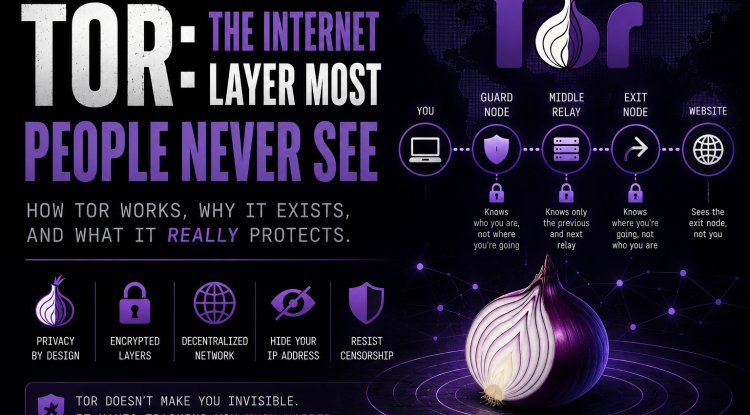
Tor is a privacy-focused network that routes internet traffic through multiple encrypted relays to make tracking users significantly harder. Instead of connecting directly to websites, Tor separates identity from destination using layered encryption and decentralized routing. Built for anonymity, censorship resistance, and privacy, Tor helps reduce surveillance — but it does not make users magically invisible or replace good operational security.
TOR: The Internet Layer Most People Never See
Most people think the internet is direct.
You type a website.
Your device connects.
The site responds.
Simple.
But that simplicity is an illusion.
Every connection exposes metadata:
-
Your IP address
-
Your approximate location
-
Your ISP
-
Your timing patterns
-
Your browsing behavior
The modern internet was not built for privacy.
It was built for connectivity.
Tor exists because those are not the same thing.
1. What Tor Actually Is
Tor stands for:
The Onion Router
Not because it is “dark web software.”
Because it uses layered encryption.
Like layers of an onion.
Tor is a decentralized anonymity network designed to make tracking internet traffic significantly harder.
The key goal is simple:
Prevent any single point in the network from knowing both:
-
who you are
and -
where you are going
That separation is the entire architecture.
2. The Problem Tor Was Designed to Solve
Normally, internet traffic works like this:
You → ISP → Website
This means:
-
Your ISP sees the destination
-
The website sees your IP
-
Multiple intermediaries can correlate activity
The internet leaks identity by design.
Tor changes the route completely.
Instead of one direct path, traffic bounces through multiple encrypted relays operated by volunteers worldwide.
Now the connection becomes:
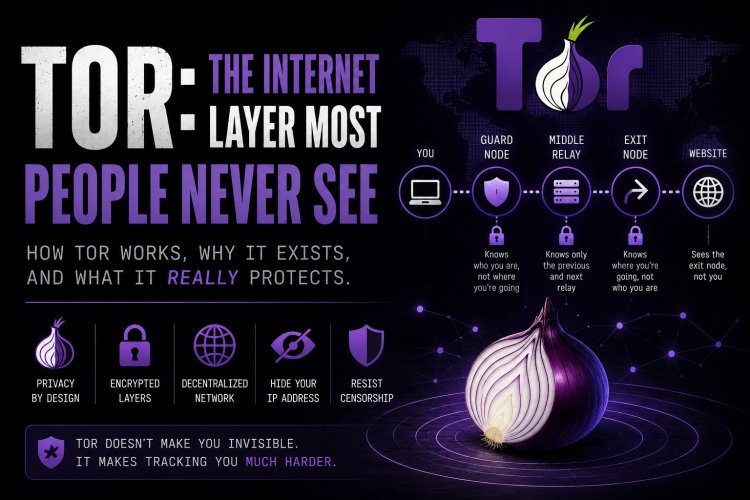
You → Guard Node → Middle Relay → Exit Node → Website
No single relay sees the entire picture.
That is the core idea.
3. How Onion Routing Actually Works
Tor traffic is wrapped in multiple encrypted layers before leaving your device.
Each relay decrypts only one layer.
Nothing more.
Imagine sealing a message inside multiple envelopes.
Each relay removes one envelope and learns only:
-
where the packet came from
-
where to send it next
But not the full route.
This creates compartmentalization inside the network itself.
The relays cooperate without fully trusting each other.
That design matters enormously.
4. The Three Core Nodes
Guard Node
This is the first relay.
It knows:
-
your real IP address
-
but not your final destination
Tor intentionally keeps guard nodes stable for longer periods to reduce exposure to malicious entry relays.
Middle Relay
The middle node acts as separation.
It only knows:
-
the previous relay
-
the next relay
Nothing else.
Its entire purpose is breaking correlation chains.
Exit Node
This is where traffic exits Tor and reaches the public internet.
The website sees:
-
the exit node’s IP
-
not yours
However:
If traffic is not encrypted with HTTPS, the exit node could theoretically view plaintext traffic.
This is why HTTPS still matters heavily even on Tor.
Encryption and anonymity are different protections.
5. Why Tor Is Slow
Speed was never the priority.
Privacy was.
Tor sacrifices efficiency for anonymity.
Reasons include:
-
Multiple relay hops
-
Encryption overhead
-
Volunteer-operated infrastructure
-
Geographic routing randomness
-
Limited bandwidth availability
People expecting Tor to feel like high-speed commercial browsing misunderstand its purpose entirely.
Tor is engineered to reduce traceability.
Not maximize convenience.
6. What Tor Protects You From
Tor can help reduce:
-
IP-based tracking
-
Basic geolocation exposure
-
ISP visibility into destinations
-
Certain forms of network surveillance
-
Direct origin tracing
It is especially valuable in:
-
censorship-heavy environments
-
oppressive regimes
-
investigative journalism
-
whistleblowing
-
privacy-focused research
For many people worldwide, Tor is not a curiosity.
It is infrastructure for communication freedom.
7. What Tor Does NOT Protect You From
This is where people become dangerously confused.
Tor does NOT automatically protect against:
-
Malware
-
Browser exploits
-
Downloaded malicious files
-
Logging into personal accounts
-
Social engineering
-
Metadata inside uploaded documents
-
Human mistakes
-
Device compromise
-
Behavioral correlation
-
Fingerprinting attacks
Tor protects traffic routing.
Not human behavior.
That distinction is critical.
8. Why Tor Browser Looks “Plain”
New users often customize everything.
That is usually a mistake.
Tor Browser intentionally tries to make users look similar.
Because uniqueness creates fingerprintability.
If one browser has:
-
unique fonts
-
custom extensions
-
unusual dimensions
-
modified settings
it becomes statistically easier to identify.
Ironically:
the more “special” your setup becomes,
the less anonymous it may become.
Anonymity often depends on blending into a crowd.
9. The Deep Web vs Dark Web Confusion
Most people use these terms incorrectly.
Deep Web
Anything not indexed by search engines.
Examples:
-
private databases
-
banking portals
-
academic archives
-
email inboxes
Most of the internet is technically “deep web.”
Dark Web
Services intentionally hidden and accessible through anonymity networks like Tor.
These use:.onion addresses
The dark web is only a tiny fraction of the internet.
Media narratives massively exaggerate it.
10. Why Governments Cannot Simply “Shut Tor Down”
Because Tor is decentralized.
No central server controls the network.
Thousands of volunteer relays exist globally.
Shutting Tor down completely would require:
-
massive international coordination
-
continuous infrastructure suppression
-
constant blocking escalation
And even then:
bridges and obfuscation mechanisms exist to bypass censorship attempts.
Tor survives because decentralization is resilient.
That is one of its strongest properties.
11. The Real Philosophy Behind Tor
Tor is not fundamentally about secrecy.
It is about power balance.
Without privacy:
-
surveillance scales infinitely
-
behavioral monitoring becomes normalized
-
dissent becomes dangerous
-
information control becomes easier
Privacy tools exist because unrestricted visibility changes human behavior.
People act differently when constantly observed.
That is not paranoia.
That is psychology.
Final Take
Tor is one of the most important privacy technologies ever created.
Not because it makes users invisible.
But because it challenges the assumption that all internet activity should be easily traceable by default.
Most people misunderstand Tor completely.
Some treat it like criminal infrastructure.
Others treat it like magical invisibility software.
Both are wrong.
Tor is simply a tool.
And like every powerful tool:
its value depends entirely on how intelligently it is used.
Conclusion
The internet remembers more than people realize.
Tor exists to reduce unnecessary exposure in a world increasingly built around data collection and behavioral surveillance.
It does not eliminate risk.
It does not replace discipline.
But it fundamentally changes one thing:
Who gets to observe whom.
And on the modern internet, that question matters more every year.